【DSE 英文】Speaking/Oral 說話全攻略|5** 發言框架、背熟呢幾句直接KO「I agree」


考完 English Paper 4 Speaking/Oral,出到考場門口係咪第一時間回想自己係咪全程都係講 "I agree with you"?係嘅話你唔孤單,大概八成考生都係咁。問題係,考官坐係度評分,聽咗十幾個 "I agree" 之後,佢哋早就麻木咗。
今篇會幫你由頭到尾拆解 Speaking:準備時間點用、Group Discussion 點發言、Individual Response 點答、加埋邊啲 edge case 最多人甩底但其實有得救。
Paper 4 Speaking考試通常係正式筆試之前幾個星期,唔好等到最後先準備。
考試格式:幾個數字要記
Paper 4佔英文科總分10%,全程約20分鐘:
| 部分 | 時間 | 內容 |
|---|---|---|
| 準備時間 | 10分鐘 | 閱讀題目、寫notes |
| Part A: Group Interaction | 約8分鐘 | 小組討論 |
| Part B: Individual Response | 每人約1分鐘 | 回答考官問題 |
Cut-off參考(歷年數據):
| 年份 | 5** | 5* | 5 | 4 | 3 |
|---|---|---|---|---|---|
| 2024 | 88% | 81% | 75% | 65% | 53% |
| 2023 | 93% | 86% | 81% | 67% | 65% |
| 2022 | 96% | 90% | 84% | 71% | 62% |
拎到5以上其實唔係要你英文特別好,係要你知道考官想睇咩。
四大評分準則:考官實際睇緊咩
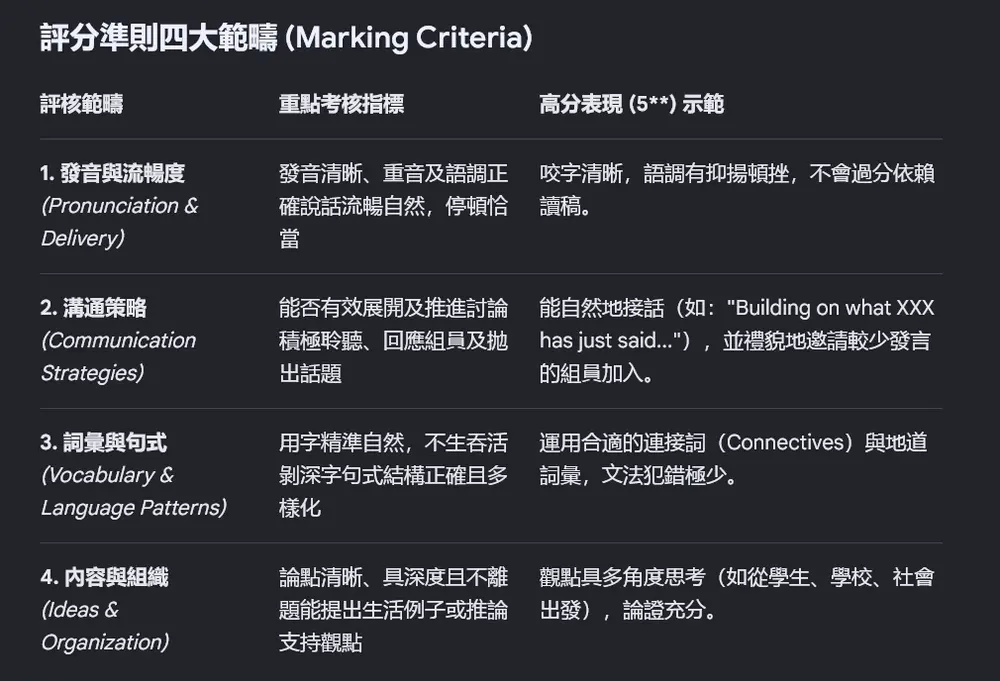
唔少人以為 speaking 就係英文叻就高分,但 HKEAA 係按四個範疇計分:
① Pronunciation & Delivery 發音同語調
唔係要你講英國口音,係要清晰、有節奏感。最常見失分:全程 monotone、語速過快、緊張時"er er er er"停唔到。
解決方案:把"er"換成"well..."、"hmm..."、"you know...",呢啲係外國人真係會用嘅口頭禪,自然得多。
② Communication Strategies 溝通技巧
考官想見到你係 group member,唔係獨自發表演說嘅人。點 invite 其他人講、點回應別人觀點、點 handle 討論方向,全部係分。
③ Vocabulary & Language Patterns 詞彙句型
唔係要你用生僻詞,係要你用準確、自然嘅表達。一句"This is important"同"This has significant implications for..."比較,後者係咁簡單都已經係差距。
④ Ideas & Organization 內容組織
你嘅發言有無立場?有無理由支撐?有無延伸?講嘢係咩去咩係扣分位。
10分鐘準備時間:唔好白白浪費
好多人拎到題目之後,就係坐係度讀咗又讀,讀到準備時間完都唔知自己要講咩。以下三步走:
Step 1(頭1-2分鐘):快讀 + #hashtag
快速讀完題目小文章,把所有相關概念以#hashtag形式寫落notecard:
例如題目係關於電話成癮(phone addiction):#mental_health #productivity #youth #screen_time #regulation #education
呢個係防止你到Q4 "anything else you think is important"嗰時口啞啞。
Step 2(中間7分鐘):每題2-3個論點
唔好只係照抄文章表面觀點。用多角度切入先係高分做法:
- 政治 / 經濟 / 社會 / 文化角度
- 個人 / 社區 / 社會層面
每個論點思考:原因係咩、有咩例子、可以點推論下去、有無反面可以駁。
只寫point form,唔好寫完整句子,因為討論係動態嘅,背稿反而會令你更僵。
Step 3(尾1-2分鐘):排練首輪發言
心入面預演一次你點開口。首輪發言只需要30秒左右,唔係一次過講晒所有論點,係確立立場 + 一個核心argument,其餘留待group互動時再展開。
首輪發言唔係越長越好。講太多反而冇位俾其他人回應,破壞group dynamics,係扣分位。
Group Discussion:SET發言框架
無論你係第幾個發言,都follow呢個框架:
S — Stand(表明立場)
回應上一位發言者嘅觀點,簡單歸納 + 表明你自己嘅立場
E — Elaboration(擴展論點)
原因 → 例子/假設推論 → 建議(如適用)
T — Transit(交棒)
轉topic、邀請其他人發言、或作小結
如果你係第一個發言,把 S 換成Start:用開場白介紹討論背景和你要回應的第一個 question。
實際例子(2019 Past Paper: Fortune Telling)
首位發言:
"Today we're discussing whether fortune telling should be viewed as a legitimate cultural practice. I believe it should be respected as part of our cultural heritage, primarily because it plays an important psychological role for many people. When someone consults a fortune teller, they're often seeking reassurance during uncertain times. That said, I'm curious what others think. [Name], what's your take?"
非首位發言:
"I see your point about cultural heritage, and I partly agree. However, I'd argue that the issue is more nuanced. Economically speaking, the fortune telling industry can sometimes exploit vulnerable individuals, particularly the elderly. Would it make sense to consider some form of consumer protection regulation? [Name], do you have thoughts on the regulatory side?"
詞彙升級表:唔好再講死嘢
以下係最常見嘅"懶嘢詞"同建議替換:
| 想表達 | 唔好再講 | 可以改用 |
|---|---|---|
| 同意 | I agree / I agree with you | I share that view / That resonates with me / Building on that point... / I'd echo what [name] said... |
| 唔同意 | I disagree | I'd like to offer a different perspective / I see it slightly differently / With due respect, I think... |
| 想補充 | I want to add | I'd like to build on that / To expand on [name]'s point... / On a related note... |
| 轉話題 | Change topic | Shifting our focus to... / Perhaps we should also consider... / Moving on to the next aspect... |
| 邀請發言 | What do you think? | [Name], I'd be interested to hear your take on this / Do you see it the same way, [Name]? |
| 舉例 | For example | A case in point would be... / To illustrate this... / This is evident in... |
| 重要 | Important | Significant / Critical / Consequential / Worth noting |
| 問題 | Problem | Challenge / Issue / Concern / Implication |
| 我認為 | I think | In my view / From my perspective / I'd argue that / It seems to me that |
| 總結 | In conclusion | To summarise our discussion... / Drawing our points together... |
唔係要你死記以上所有句式。揀番5-6個你自己用起上來自然嘅,集中練熟佢哋。
Individual Response:1分鐘點答
考官會係 Group Discussion 之後問你一條相關問題,要你個人作答。時間只有1分鐘,結構係關鍵。
PREP框架:
| 步驟 | 內容 | 建議時間 |
|---|---|---|
| Point | 直接表明立場/答案 | 10秒 |
| Reason | 1-2個核心原因 | 25秒 |
| Example | 具體例子或假設情境 | 15秒 |
| Point (restate) | 簡短重申立場 | 10秒 |
對比法加分: 先講一面,再用 "However / On the other hand"帶出另一面,再說明你傾向哪方。即使同意某個立場,都展示到你有多角度思考。
例:
"I believe schools should limit smartphone use during class time. The primary reason is that constant notifications significantly disrupt focus. Research from classrooms in Finland, for instance, found concentration improved notably after phone-free policies were introduced. On the other hand, total bans might be counterproductive as phones can serve as learning tools. Overall though, I think structured limits strike a better balance than outright prohibition."
Edge Cases:考場突發情況點搞
呢啲情況每年都有人遇到,但係冇人 teach 你點 handle。
情況一:其他人唔係咁講嘢
有人鬼噤,你唔可以放佢哋係度唔理,因為 group dynamics 係評分的一部分。
點做: 直接、有禮貌地 invite:
"[Name], we haven't heard your thoughts on this yet. Do you think the benefits outweigh the drawbacks?"
唔好用"Do you agree?",太封閉,改用open-ended問題。
情況二:有人 dominate 晒成個 discussion
一個人講晒,你搵唔到機會插咀。
點做: 係佢講完之後立即接話,唔好等:
"That's an interesting point. I'd like to add a different dimension to this..."
或者直接轉scene:
"We've explored that angle quite thoroughly. Perhaps we could also consider the economic implications?"
唔好等人讓你講,主動爭。
情況三:聽唔清楚題目或其他人講話
緊張、考場噪音、對方口音。
點做: 唔好扮聽到然後亂答。禮貌地要求repeat:
"I'm sorry, could you repeat that? I want to make sure I address your point properly."
"Sorry, I didn't quite catch that. Could you elaborate?"
考官唔會扣你分因為你問咗人 repeat,但係你答答下離題係會扣。
情況四:腦海一片空白,唔知講咩
Dead air係最恐怖嘅敵人。
點做: 用 filler sentence 爭取時間,同時唔好停下來:
"That's a thought-provoking question. Let me think about this from a different angle..."
"There are a few dimensions to consider here. First..."
開口就係贏,即使係 filler。
情況五:自己犯咗 grammar 錯誤
講咗出口先發現錯,點算?
點做: 如果係 minor error,繼續講唔好停,唔好"oh wait let me redo that",咁反而更尷尬。如果係影響意思嘅錯誤,可以自然地補充:
"...what I mean to say is..."
唔好係口試當中多次中斷自己去糾正,係流暢度扣分。
邊個說話多、邀請多、回應多,邊個拿高分嘅機會就大啲。被動等人問你係最低分策略。
在家點操?
冇 partner 都可以練:
- 去 HKEAA 下載 past paper 題目(有齊歷年speaking topics)
- 計時10分鐘做準備,然後對住鏡頭或錄音機講個首輪發言
- 聽返自己嘅錄音,check:有無"er er er"、語速係咪太快、有無清楚表明立場
- 練完一個topic,換另一個,唔好只操同一條
最有效嘅練習係把自己錄下來,因為你聽到自己講嘢係會即刻發現問題,比人話你知更直接。
如果你想知自己目標分數對應邊間大學邊個 program,dse.best 嘅 JUPAS Calculator可以幫你計:
歷年Cut-off數據可以睇: